48-72h
Turnaround
Trained trade-research analysts spend 48-72 hours producing one report per company: CEO direct phone, complete decision-maker map, financial health, risk flags, recommended outreach approach. No competitor in the trade-data category offers this.

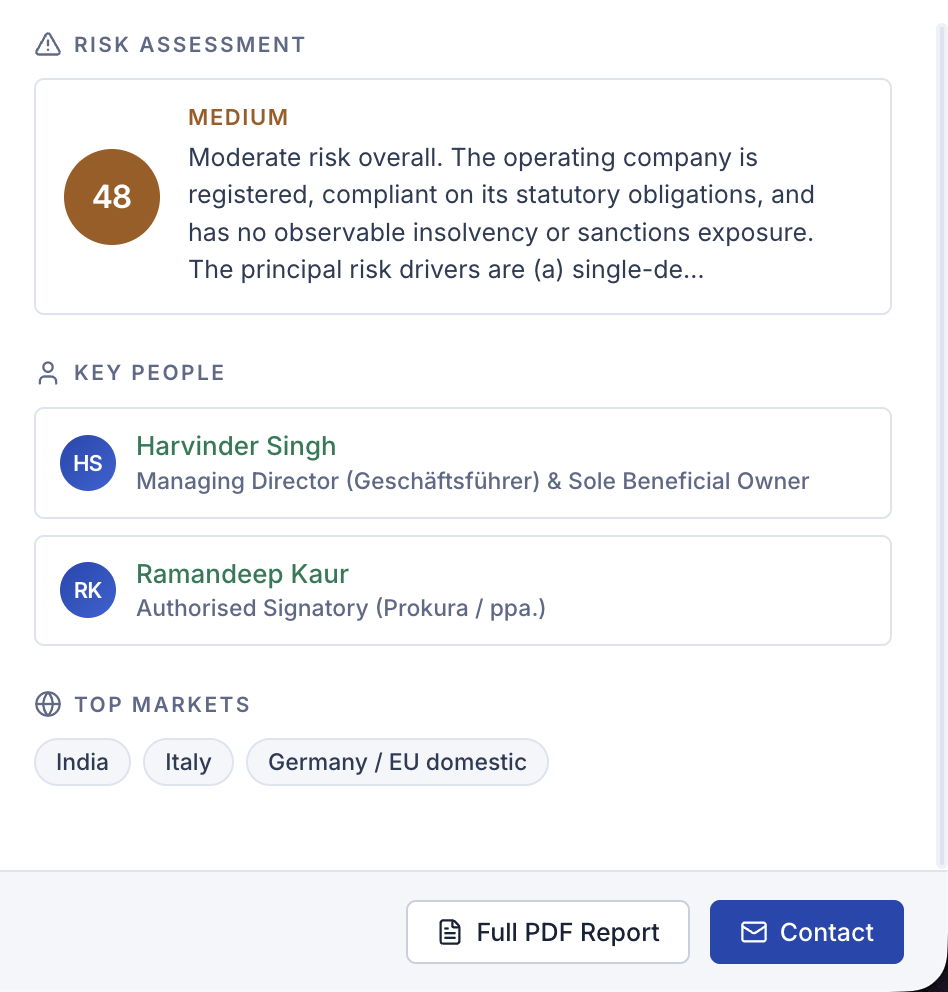
Every report opens with an executive summary: sector, classification, country, date and a plain account of what the company actually does.
Software finds patterns. Humans find nuances. ShipScout's automated trade-data and contact-intelligence layers tell you which companies import what, who works there, and how to reach them. But when you're chasing a $2M PO with a tier-1 buyer, automated data doesn't tell you that the procurement head's brother runs a competing supplier, that the parent company in Singapore actually controls the purchasing decision, or that the company filed for restructuring 11 weeks ago. That is what Contact Intelligence Reports are for, and no competitor in our category offers them.
Direct phone (not switchboard), personal email where available, LinkedIn, WhatsApp, and ideal time-of-day to reach. Verified by analyst, not scraped.
Org-chart of who actually approves purchases: technical evaluator, commercial buyer, finance signoff, board approval. Names, titles, tenure, reporting lines.
Holding company, sister concerns, group structure. The actual buying entity vs the holding. Who really controls the budget and procurement policy.
Revenue range, employee count, growth trajectory, debt signals, late-payment history (where public), credit rating where available. Are they good for the LC?
Litigation history, sanctions list checks (OFAC, EU, UN), blacklist appearances, regulatory penalties, ESG controversies, recent layoffs or asset sales.
CEO/CPO/CFO transitions in the last 24 months. New buying preferences come with new buyers. Recent hires from competitors are a tell.
Existing supplier relationships from customs declarations + analyst due diligence. Who they currently buy from, contract values, switching signals.
How they buy: tender, RFQ, direct nego, framework agreement. Decision cycle length. Sample-to-order timeline. Payment terms they typically accept.
Analyst recommendation: who to contact first, the right channel (LinkedIn vs email vs intro), the message angle most likely to land, and the angles to avoid.
Other providers are all software products. They scale by automation. Their margin economics depend on zero human cost per query. That ceiling means their output is, by design, what software can extract. Anything that needs a human to read a 10-K, call a switchboard or cross-reference local regulatory filings falls outside that model, and stays undone.
Our self-serve platform gives you the same automated data layer (trade flows, contacts, news). On top of it, we run an analyst desk producing manual reports for high-stakes targets. You burn an automated lookup on 200 prospects to filter your list. You burn a manual report on the 5 prospects worth $500K+ each. Different tools for different stages of the funnel.
Every report is produced by an analyst trained in international trade research: Incoterms, LC mechanics, customs clearance and the red flags that recur by jurisdiction (e.g., shelf companies in BVI, common Russian sanctions evasion patterns, common Indian related-party-transaction structures). They know what to look for because they've looked for it 500 times before.
An exporter targeting a German chemicals distributor with €40M revenue ordered a Contact Intel Report. The automated data showed a clean profile. The manual report surfaced: (1) the parent company in Switzerland actually owned procurement, (2) the German MD was leaving in 60 days based on LinkedIn signals + an industry-press mention, (3) the incoming MD had previously worked at a direct competitor of our customer's existing supplier, (4) a court filing showed the parent had won a chemical-supply tender in Singapore that would expand their pull-volume by 35%. The exporter pivoted: routed the pitch through the Swiss parent's CPO, mentioned the Singapore tender, and timed the proposal to land 2 weeks before the new MD started. Won the contract. Pure data couldn't have built that play.
Every report ships in two formats:
Reports are priced per company on a credit basis. Standard turnaround is 48-72 hours. Rush 24-hour turnaround available for high-priority targets. Volume discounts kick in at 10+ reports/month. Confidentiality: every report is covered by a signed NDA between ShipScout and the analyst, and your target list never leaves the platform.
Find a high-stakes target in ShipScout, review its automated profile of trade flows, contacts and relationships, then order a manual Contact Intel Report on the few accounts worth $500K+. The finished dossier lands as branded PDF and structured JSON, ready to circulate or push to your CRM.
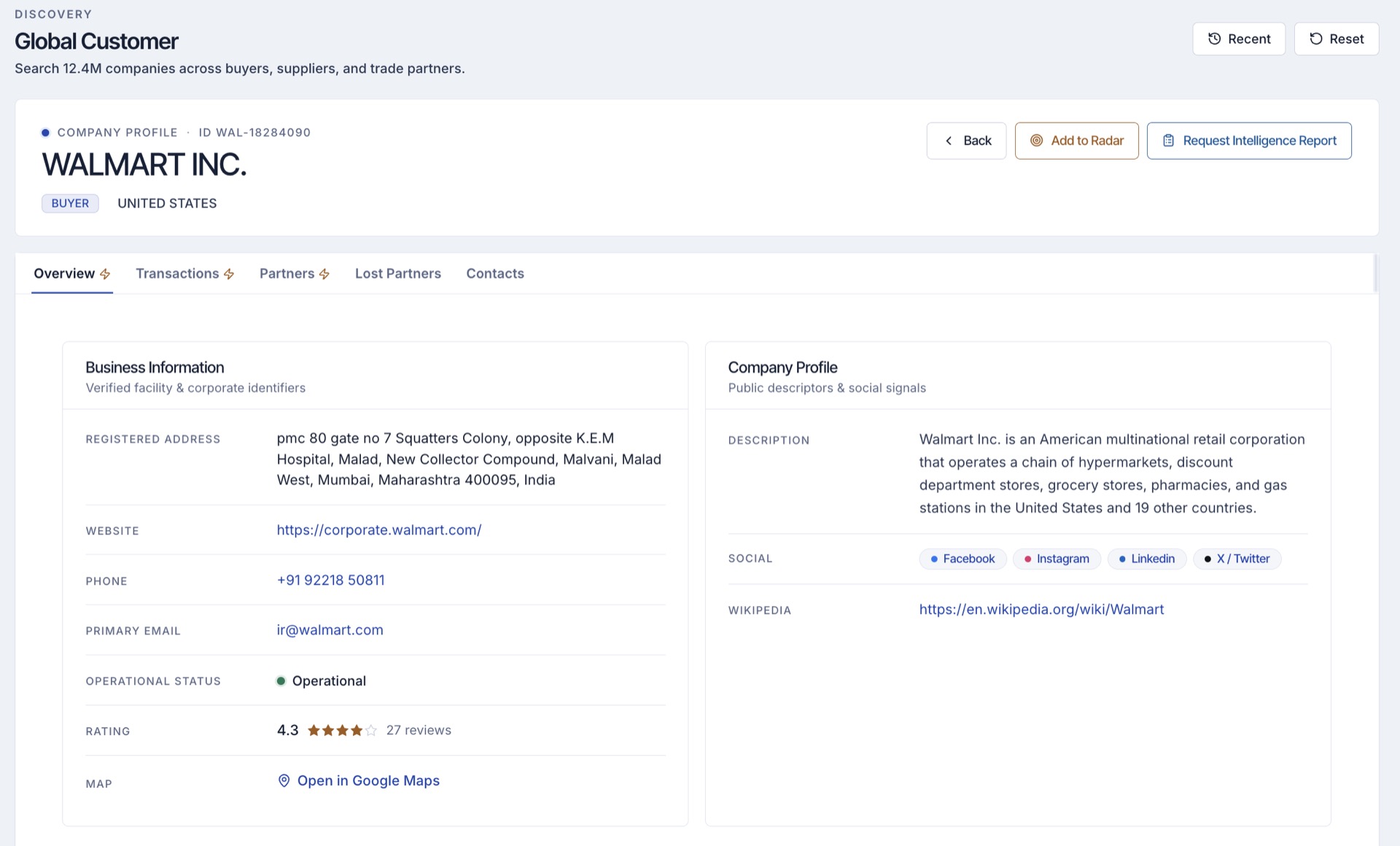
Order one report. See what 48 hours of expert research surfaces about your top target.