11.3B+
Shipment Records
Stop guessing what to launch. ShipScout shows which countries are importing your product, who is already buying it and which competitors are doing well, from 11.3B+ customs records across 150+ countries.

Most Amazon, Shopify and eBay sellers pick products with three blunt tools: a Jungle Scout keyword score, a TikTok dropshipping list, and gut feel. Then they ship 500 units to FBA and pray. ShipScout replaces all three with the one signal that actually moves: real customs declarations. If 18 importers in Germany pulled in 2,400 metric tons of organic mango pulp last year, that isn't a hunch, it's a market.
Keyword tools tell you what people type into a search bar. Customs data tells you what people actually paid money for, in what quantity, at what price, into which country. Sourced from US Customs and Border Protection (CBP), EU Eurostat, and 80+ national port authorities, with India trade flows delivered via licensed mirror sources, ShipScout's dataset captures the unit-level reality that Amazon scraper tools simply don't see.
For a private-label seller, the difference is everything. A keyword score can't tell you that 73% of US imports of a SKU come from one Vietnamese factory, or that the factory's MOQ is 3,000 units at $2.40 FOB. Customs data can.
Search HS code 2007.99 (fruit purees), filter destination = Germany, filter origin = India. Get back: 14 active importers, monthly tonnage by buyer, average CIF price per kilo, and the German distributor names that buy directly without a broker. That's a list-building exercise that took 20 minutes instead of a multi-week trade-consultant engagement.
Search HS code 4016.91 (rubber mats), origin Vietnam, destination United States. Sort suppliers by export volume, filter to those who ship FOB to Long Beach, then run a contact intelligence report on the top 5 to get factory owner WhatsApp, factory size, and current customer list. Skip Alibaba's middlemen entirely.
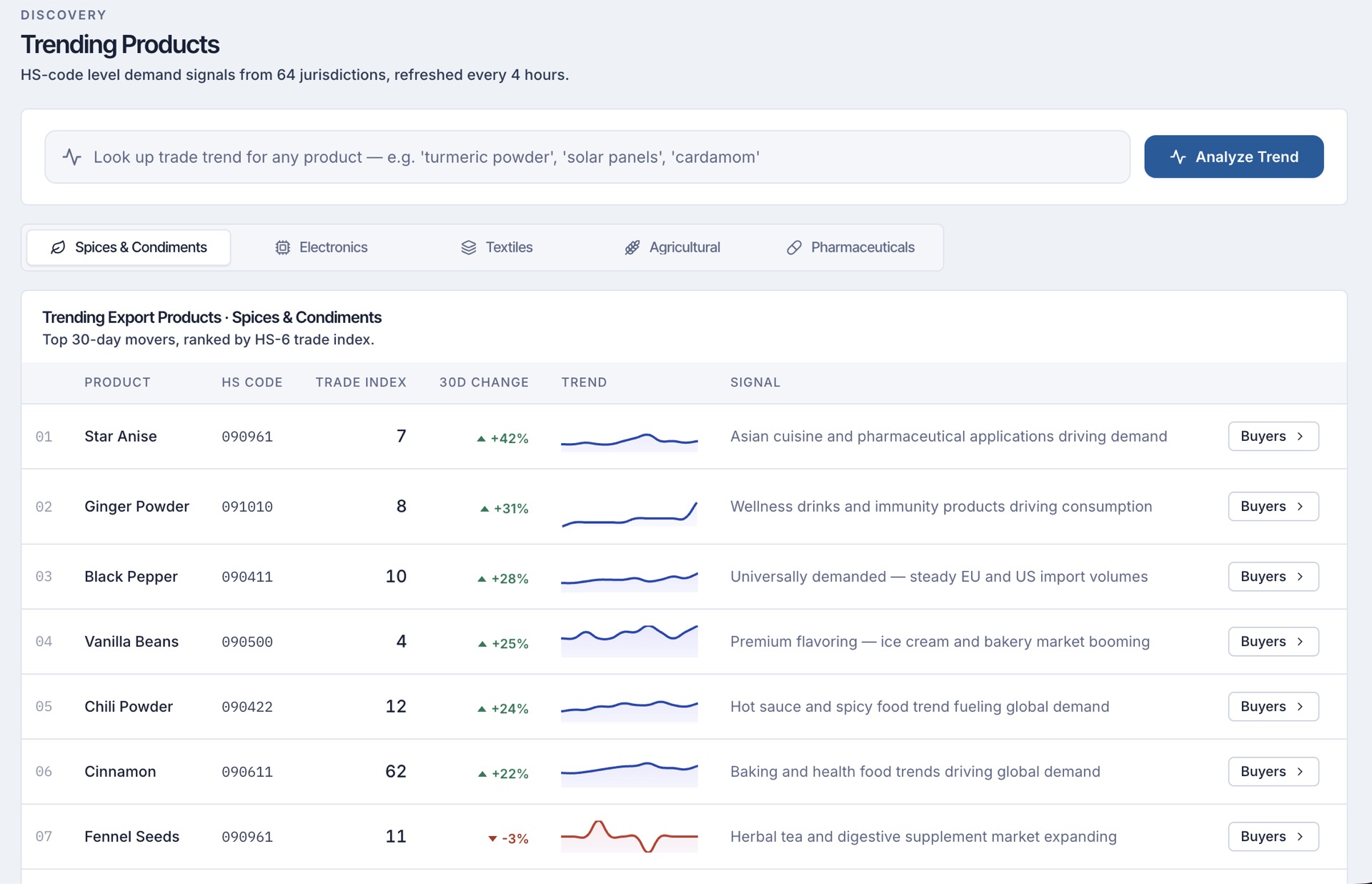
That LED dog collar everyone's talking about? Pull 18-month US import volume on its HS code. If it spiked 400% YoY, you're at the start of a wave. If it's been flat for three years and someone just slapped a TikTok ad on it, you're buying scraps. ShipScout's Trending Products module flags exactly this.
Most domestic Shopify sellers never export because they don't know how. ShipScout flips that: enter your product, pick a country, see every importer there with shipment volumes and contact data. Now you have a B2B export pipeline that runs alongside your DTC brand.
Type a competitor brand into Company Search. See every container they imported, the factory they bought from, the unit price they paid, the port of arrival. If their landed cost is $1.80 and yours is $3.20, you just found why they're outpricing you.
Confirm import demand for a SKU in 14 target countries before you commit a single dollar to inventory.
Skip Alibaba traders. See the actual exporting factory, their volume, and their existing customers.
Catch import-volume spikes 6-12 months before they hit Amazon best-seller lists.
Replicate a winning US listing across UK, Germany, Australia using import-volume rankings.
See the supplier, MOQ, unit cost, and shipping cadence behind any competing brand.
Email and LinkedIn campaigns to 100 verified factories without leaving the dashboard.
ShipScout gives sellers full global trade access for a fraction of what the other providers charge on an enterprise contract. Annual plans include the CRM suite, contact intelligence credits, and unlimited company search. See full pricing →
Every shipment record on ShipScout traces back to a primary government source. India records are delivered via licensed mirror sources covering import & export trade flows. US records come from CBP's Automated Manifest System (AMS) for waterborne cargo. EU trade flows are reconciled against Eurostat Comext. Latin America, Africa, and APAC sources draw from national customs declarations, port authority manifests, and bill-of-lading registries. The result: 11.3B+ records that ecommerce sellers can actually trust for sourcing decisions.
Unlike scraper-based competitor tools, ShipScout doesn't infer; it reports what was declared at the border. For private-label brands evaluating a six-figure inventory commitment, that distinction is the difference between a launch and a write-off.
The trending dashboard ranks HS codes by real import momentum across destination markets, so you pick products from customs signal rather than guesswork.
Join hundreds of exporters and importers already using ShipScout to find suppliers, track competitors, and discover new markets.